ENGLISH CATHOLICISM
Christianity has a long history in the British Isles, with a presence attested as early as the 1st century AD.
The Anglican (English) Christian tradition is that of the Church of England and her “daughter” churches. Anglicanism can then be thought of as “English Catholicism” or “English Orthodoxy”, particularly as it developed during the English Reformation and the pursuant debates of the 16th and 17th c.
But time doesn’t stand still, and today’s Anglicanism has been shaped by various movements, even as those movements sometimes led to altogether new groups: Laudianism, Puritanism, Wesleyanism, Tractarianism, the “Continuing Anglicans”, and the ecumenical and charismatic renewals, to name a few. Many of today’s denominations can trace their roots to the CoE (with varying degrees of evidence): Baptists, Congregationalists, Methodists, Presbyterians, Quakers.
ANGLICAN DISTINCTIVES
Though Anglicanism is often described as a “big tent”, with a greater range of practice and belief than one might find in other denominations, most Anglicans can be defined by a general emphasis on both Scripture and Tradition, including holding to practices that may not be found explicitly in Scripture, but are not contrary to and even support it (e.g. Lent). Bp. Ashley Null writes:
Although it’s common among Anglicans to speak of the three-legged stool of Scripture, Tradition, and Reason, in which each leg is equal, it is far more accurate to speak of Scripture as a garden bed in which reason and tradition are tools used to tend the soil, unlock its nutrients and bring forth the beauty within it.
Some of Anglicanism’s distinctives include:
- Liturgical worship
- Lex orandi, lex credendi: sometimes translated as “the rule of prayer is the rule of belief”, this 5th century expression from Prosper of Aquitaine describes how prayer and belief are closely interconnected.
- All churches follow some order of events, but “liturgical” traditions such as Anglicanism follow a more detailed rubric for each church to follow. Like ancient pathways, these help shape and guide us, and keep us from “straying” unintentionally.
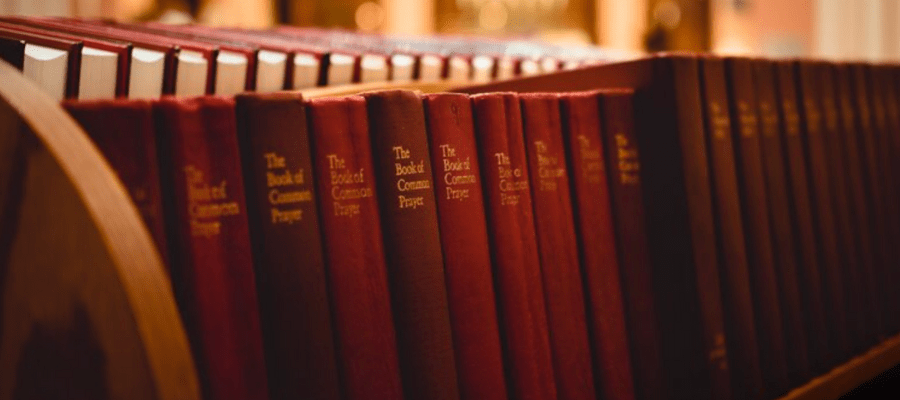
- Book of Common Prayer
- Described as “the Bible arranged for worship”, this text was first compiled by Thomas Cranmer in 1549 and 1552, drawing on the best of the apostolic and medieval traditions (Use of Salisbury, Mozarabic Rite) to create a “Reformed Catholic” set of services, rubrics, lectionary, prayers, and Psalter to be used by all in the Church.
- The 1662 edition remains the official prayer book of the CoE and has had an enduring impact on both the Church and the English language (“Dearly beloved…”).
- The 2019 BCP is the current standard edition for use in ACNA parishes.
- Scripture
- This might not seem like much of a “distinctive”, but Anglican worship is saturated in God’s Word (the BCP consists of upwards of 80% Scripture), and one will hear a significant portion of the Bible over several years from the Sunday readings alone.
- If one were to follow the daily lectionary, they would read all of Scripture, the Gospels & Acts twice, and the Psalms 6-12 times over all in a single year—in addition to various “Apocryphal” selections sprinkled throughout.
- Tradition
- As settled following the English Reformation, Anglicans lean towards the “normative” principle of not abandoning historical teachings and practices where they are found to be congruent with Scripture. These include, to name a few, the church calendar, the commemoration of “saints” who have come before us, structured (as well as extemporaneous) prayers, and vestments.
- To quote the well-loved Bishop Lancelot Andrewes, “One canon [Bible], two testaments, three creeds, four councils, and five centuries [Church Fathers]”. Of course, many Anglicans like the other ecumenical councils too 😎
- Sacramental theology
- While most Christians acknowledge the importance of baptism and Holy Communion as dominical (ordained by Christ) sacraments, Anglicans typically hold to “higher” views of their meaning and role in Christian life as compared to many Protestants.
- Anglicans often hold similarly higher views about the “other” sacraments (confirmation, ordination, matrimony, penance, and anointing of the sick).
- Vestments
- Much like a judge in a courthouse or public safety officers, Anglican ministers wear “uniforms” that vary according to the occasion and season. Vestments are not merely to seem “old”—although Anglicans value historical continuity—but are rich in symbolic meaning. They also (perhaps counterintuitively) divert focus away from the individual and to their office, from the created towards the Creator.
- While the clerical collar is today associated most strongly with Roman Catholicism, its use began in the mid-19th c. by a Presbyterian minister, and adoption gradually spread across the Church.
- Episcopal polity
- Anglicans hold to “rule” by bishops as part of a threefold ministry of deacons, presbyters (“priests”), and bishops, following the New Testament pattern where Christ’s apostles instructed their successors to appoint further successors (cf. Titus 1:5). This structure still holds today, albeit with a greater degree of involvement encouraged from the laity.
- Bishop derives from the Greek episkopos, hence the term “Episcopal”.
- The “Apocrypha”
- Also known as the deuterocanonical books, the additional texts found in the Septuagint (Greek Old Testament) are “as Jerome saith, read for example of life and instruction of manners; but yet doth it not apply them to establish any doctrine.” (39 Articles, VI)
- Creeds
- “The Three Creeds—Nicene Creed, Athanasius’ Creed, and that which is commonly called the Apostles’ Creed—ought thoroughly to be received and believed for they may be proved by most certain warrants of Holy Scripture.” (39 Articles, VIII)
- Formularies
- Often considered as setting the “bounds” or norms of Anglican theology and practice, the formularies traditionally include:
- Thirty-Nine Articles of Religion (1571)
- Book of Common Prayer (esp. 1662)
- Ordinal (ordination services)
- Sometimes also included are the two Books of Homilies (sermons intended to address the shortage of trained preachers in the 1500s) and the Canons of 1604 (church law).
- Often considered as setting the “bounds” or norms of Anglican theology and practice, the formularies traditionally include:
- Worshipping in the local language
- No longer distinctive today. But it was once!
For an even more in-depth overview of Anglicanism, see Jesse Nigro’s excellent article.
 CCA in Branford